An eye into your process – Specac process flow cells inspire confidence on the frontline of your PAT solution.

Specac aims to provide robust solutions for reliable Process control. We are constantly innovating to provide sample interfaces that meet the harshest of environments for the safety of our customers and those around them.​

We aim to give customers peace of mind when monitoring their processes so that their operators and employees feel safe and in control.​

Utilising advanced process control reduces carbon footprints and waste. Specac is proud to play its part in the Green transition of industrial chemistry.
Setting the standard

Why choose Specac

We consult with your engineers to understand your process requirements.

Cell solutions at all stages, from feasibility to full scale production.

Proven track record in the most demanding industrial environments.

Continued support for servicing and repairs for years to come.

Our process flow cells

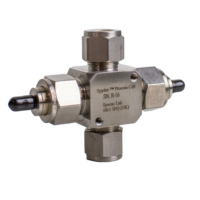
Typhoon

1
  • Single-pass gas cell for on-line PAT installation.
  • Swagelok process connections.
  • Custom materials, pathlength, and optics specification.
  • Factory aligned.
  • Optional cross-flow optics cleaning ports, thermocouple, and protective hoods for fiber connections.
  • Up to 200 °C and 160 bar g process conditions*.
  • View Datasheet

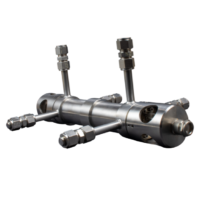
Vortex

2
  • Transmission flow cell for on-line NIR analysis of liquids.
  • DIN or ANSI flange connections.
  • Custom materials, pathlength, and optics specification.
  • Factory aligned.
  • Optional leak tell-tales for the primary seals, thermocouple, vacuum capability, cleaning port, and protective hoods for fiber connections.
  • Up to 200 °C and 160 bar g process conditions*.
  • View Datasheet

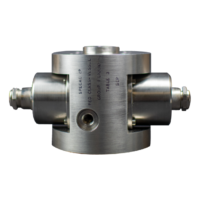
Spyder

3
  • Transmission flow cell for laboratory or pilot-scale use.
  • Pathlength set by the user†.
  • Swagelok process connections.
  • Up to 200 °C and 30 bar g pressure*
  • Available now!

* Depending on configuration.
† Adjustable or permanently selected, depending on configuration.

Not sure which Cell fit your application?
Don't worry, our cells can be customised according to your need!

Key Features

Reliable sampling.

Process optimization

Quality assurance and Safety

Designed to withstand the
harshest environments.

Measurements with the speed of light

Rugged. Robust. Reliable

Easy Installation

Advanced Custom Features

Featured Resources

(Process Cells) AN24-03: Optimising process NIR analysis with the tuneable-pathlength Spyder™ process flow cell

In this article, we demonstrate the feasibility of measuring water in acetone by NIR spectroscopy at various pathlengths using an adjustable Spyder™ process flow cell, as a prelude to full-scale implementation of NIR process analysis on a production line.

(Process Cells) AN24-02: Continuous Industrial Acetic Acid Production Process Monitoring using the Vortex™ process flow cell

Find out how Specac can aid your industrial process adding continuous monitoring to your flow reaction.

(Process Cells) AN24-01: Monitoring Tall Oil Distillation using a Vortex™ process flow cell

Learn about the chemical information that can be derived from Near-infrared measurement of Tall Oil refinery processes.

(Process Cells) AN18-09: Transmission Cells for the NIR Analysis of Liquid and Vapour Phase Process Streams

The fundamental advantage of using NIR analysis is real-time in-situ analysis of your industrial process.

Design of NIR process cells for Process Analytical Technology (PAT)

Specac’s NIR process cells designs’ influences

The origins of Specac’s involvement in PAT

Since the foundation of the company in 1971, Specac has been at the forefront of developing innovative spectroscopic solutions..

Stages of online NIR installations

When specifying a spectroscopic online monitoring system, there are many stages of design and review to proceed through…

Design considerations for sampling of liquid process streams with NIR process cells

With decades of successful installations in industry, NIR spectroscopy is still the most cost effective and standard method of choice for the application of process analytical technology. ..

The benefits of on-line NIR analysis in a continuous process

The process stream can contain liquids, gases or even solids (catalyst particles, rust, dirt) and sometimes mixtures thereof…

Use of fibre optics in NIR on-line spectroscopy

Our process cells at Specac come with standard SMA 905 connectors to couple them to the optical multiplexer and the NIR spectrometer.

Contact Us

Frequently asked questions

Process cells are the interface between a chemical process stream and its dedicated process measurement systems. They bring light to the chemistry of your process stream, literally and figuratively.

They are subject to sometimes extreme physical demands: both from the chemistry inside the process stream and the environment outside. These conditions are often more hazardous to personnel, which is why safe means to install and service the system can be as important as the in-service requirements.

On the other hand, process cells are also required to provide a path for ultraviolet, visible, or near-infrared light to probe the chemical composition of the materials inside the cell: this requires robust optics, precision fitment, and above all, physical stability over the life of the cell.

Before design of a new process cell can commence, the designer needs to know several facts about the chemical process that it will come into contact with.

This includes temperature and pressure of the process, the physical properties of the material (solid, liquid, powder, gas, particulate, etc.) and its chemical compatibility with would-be cell materials.

Once the process parameters have been specified and a solution has been chosen, the next factor will be the installation of the cell into the process. This can be a direct installation in-line with the main process pipework, or it can involve a “double block and bleed” arrangement on a bypass loop.

Specac process cells are suited to an array of processes, with customisable options available for both liquid and gas analysis. Some examples of previous process cell uses can be found in our application notes. If you would like to explore an application that we have not previously covered or have any queries regarding our process cells, please contact us to arrange a consultation.

Specac process cells use a sapphire window, a material with a friction coefficient second only to diamond. Fouling is therefore minimised, should you still have concerns we recommend adding a cleaning port to your cell configuration so that optics can be manually cleaned as needed. If this is not a desired option, cycling of temperature and/or flow rate may aid in the removal of fouling from optics.

Specac flow cells work with a wide range of spectrometer options, provided the optical connections are compatible. Typically, Specac cells employ SMA905 optical connections, so any spectrometer using these would be suitable to connect to Specac cells.

The maximum operating distance of an optical system is dependent upon spectroscopic range. Typically, fibre optics enable connection of Specac process cells and spectrometers across substantial distances, with a 1km spectroscopic range usually feasible.

Specac has solved the most difficult NIR PAT sampling issues for more than 30 years and has been interfacing it’s products with many leading OEMs of NIR spectrometers. Specac is also very proud to have an extensive network amongst leading suppliers of sampling cabinets for liquids and gases to be drawn upon.

The first stage in specifying a new on-line NIR spectroscopy installation is to conduct feasibility studies on the chemical process. This determines whether the chosen process is even suitable for analysis by on-line NIR.

At the next stage, a pilot plant will be built. This tests the system separately from the main process plant, allowing data to be collected on how the pilot system performs in comparison to the regular process.

If all these tests are passed, the go-ahead will be given for full-scale implementation on the main plant.

The requirements for the corresponding process cells can differ at each of these stages.

Flow diagram of the building blocks of a chemical process installation.


Read more: Stages of online NIR installations

Light is transmitted via an optical fiber cable from the spectrometer source to one port of the process flow cell. Collimation optics then direct this light beam through a set pathlength of process stream to a second set of optics which re-focus the beam to a return optical fiber cable attached to the second process flow cell port.

The return optical fiber cable serves to transmit the light beam back to the spectrophotometer detector. Process flow cells are typically installed as part of the process circuit either directly in the process stream or in a ‘by-pass loop’. By adopting the process flow cell in a ‘by-pass loop’ configuration, the user has the opportunity to isolate the process flow cell from the process cell for routine cleaning, servicing or calibration. Hazardous process flows should be suitably isolated before the cell can be safely removed from the installation.

Installation of a process cell
Installation of a Specac Typhoon gas-phase process cell (top of image) on a chemical plant.

There is no fixed number of NIR cells on a chemical production facility, this can range anywhere between 1 and 6. The beauty of an NIR system is the option to multiplex between different cells which can be hundreds of metres apart from each other and analyse different process streams. The process streams can have different compositions and physical states (gas and liquid cells on one spectrometer)