


People often ask questions like “what is the difference between FTIR spectroscopy and IR spectroscopy?” Or “what is the difference between ATR and FTIR?”
This short explainer will aim to answer this definitively, since it happens to be our area of expertise!
What is IR spectroscopy?
Infrared (IR) spectroscopy is the study of how materials respond to wavelengths of light within the infrared portion of the electromagnetic spectrum. An infrared spectrum shows how a material absorbs or reflects light at different wavelengths or frequencies of this light. The spectrum is measured with a spectrometer.

Infrared light comprises everything longer in wavelength than visible red light at around 700 nanometers wavelength up to around 1 millimeter in wavelength. It is therefore an extremely wide range, spanning over three orders of magnitude in wavelength.
For practical purposes, we usually subdivide the infrared into smaller parts. There are many ways this can be done, but one common classification divides infrared into near-infrared (NIR), mid-infrared (MIR), and far-infrared (FIR) parts.
| Range | Wavelengths (µm) | Frequency (cm-1) | Molecular interactions |
|---|---|---|---|
| Near infrared (NIR) | 0.7—2.5 | 14,285—4000 | Electronic transitions in atoms and molecules; combinations and overtones of vibrational modes. |
| Mid infrared (MIR) | 2.5—25 | 4000—400 | Fundamental vibrational modes of molecules; rotational modes of gases. |
| Far infrared (FIR) | 25—1000 | 400—10 | Group vibrational modes of molecules and lattices; fundamental vibrational modes. |
To make a practical infrared spectrometer, you need a source of infrared light, a sensor that responds to infrared light, and an optical set up that enables you to measure how much light is falling on the detector at discrete wavelengths within the range. There is no single spectrometer that can measure the whole infrared range, from just by the visible right through to the millimeter wave region. That is because there is no single combination of sources, detectors, and optics that can do it all.
FTIR spectroscopy is a kind of IR spectroscopy
FTIR stands for Fourier Transform IR. It uses an optical device called an interferometer to scan through different combinations of wavelengths.
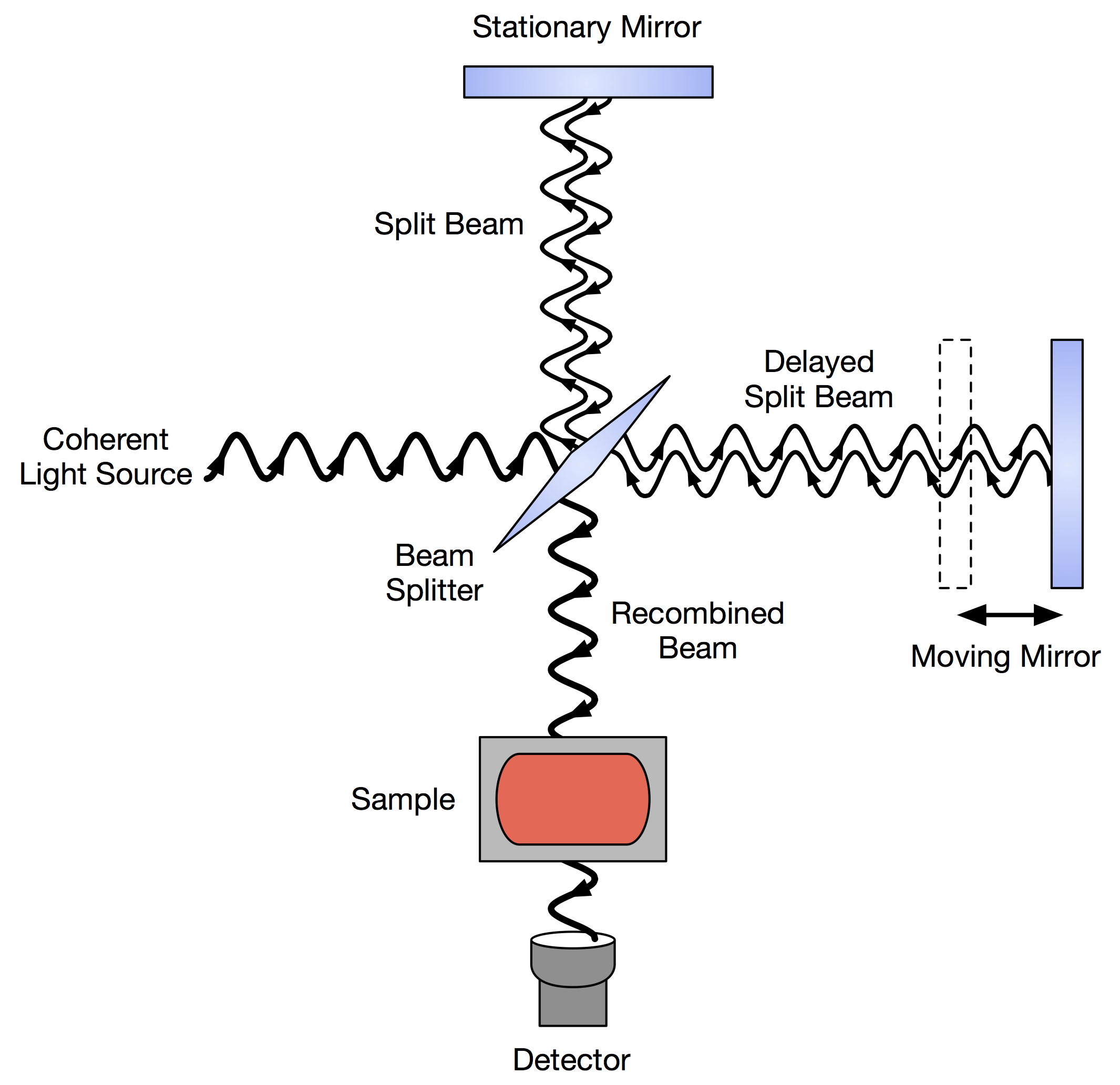
In its commonest form (the Michelson interferometer) it uses a beamsplitter to divide a beam of light into two paths. At the end of each path is a mirror that reflects the beam back to the beamsplitter, where it is recombined into a single beam that is used to interrogate the sample. If the distances to the two mirrors from the beamsplitter are equal, then all wavelengths of light in the beam recombine in phase. Whereas if one of the mirrors is moved back slightly to create a longer path than the other, wavelengths in each arm of the interferometer recombine out of phase, causing destructive interference in some wavelengths.
If one of the mirrors is mounted on a moving carriage, it can be “scanned” back and forward, causing the destruction of different wavelengths in different positions. The spectrometer outputs an interferogram which shows the total energy of light at every position of the mirror. A mathematical procedure called the Fourier Transform converts this into a spectrum of energy at different wavelengths, or rather, at the inverse of different wavelengths – a quantity known as a wavenumber, which is typically reported in reciprocal centimeters (cm-1).


FTIR versus Dispersive IR
Another common way to measure infrared light at discrete wavelengths is to use a prism or diffraction grating. These systems are conceptually easier to understand, since most people will have seen the diffraction of light by prisms. They are known as dispersive spectrometers, because each wavelength is dispersed to a different location in space. We can then use a single detector to measure light at each location in turn, or we can place an array of detectors across the whole span in order to measure several wavelengths simultaneously.

Specac’s Quest ATR accessory
Dispersive spectrometers tend to be used for the near-infrared range, while FTIR spectrometers are preferred for the mid-infrared and far-infrared. This is mainly driven by the IR source and IR detector technologies available for each range. Given sources and detectors for the mid-infrared range, FTIR spectroscopy offers better signal-to-noise (SNR) and is often faster than dispersive IR systems.
Near-infrared systems are common for online process monitoring because they can be connected to remote sensing process cells using optical fibers.
I’ve heard about ATR and FTIR: what’s the difference?
ATR stands for Attenuated Total Reflectance. It is a technique which harnesses the phenomenon of evanescent waves to very sensitively measure the IR spectrum of a material. The evanescent wave is a type of standing wave that occurs where light is totally reflected at the boundary between two media. An ATR accessory is a device used in conjunction with an FTIR spectrometer to take advantage of this phenomenon.

The wave stands on the opposite side of the boundary from the reflected light, with an effective height of several microns. The accessory consists of a small reflecting prism, or “crystal”, which is placed in very close and firm contact with the sample material. Liquids placed on the crystal will naturally form a single reflecting boundary, but solid materials must be firmly clamped into place. Optics placed below the crystal direct light from the spectrometer into the prism, setting up a total internal reflection at the boundary between the crystal and the sample. The evanescent wave forms on the sample side of the boundary. Molecules in the sample can absorb energy from the evanescent wave, leading to an attenuation of the reflected beam below that is detectable by the spectrometer.
In recent times ATR has become the commonest method of acquiring an FTIR spectrum. That’s because it is fast and convenient compared to other techniques, while the equipment itself is usually easier to protect from damage than, say, a set of KBr windows used for transmission spectroscopy.
The combined system is sometimes known as FTIR-ATR or ATR-FTIR, but the technique is so often used that confusion between “FTIR” and “ATR” is perhaps inevitable! Google Scholar estimates 18,000 articles published in 2022 include one of these terms.
-

Harrick Praying Mantis™ Diffuse Reflection Accessory
£0.00 Add to Enquiry -
Quest | High throughput ATR accessory
£0.00 Add to Enquiry -
Golden Gate | Diamond ATR accessory
£0.00 Add to Enquiry -
Harrick Seagull™ Variable Angle Reflection Accessory
£0.00 Add to Enquiry -
Omni Cell | Demountable Liquid Cell
£0.00 Add to Enquiry -
Harrick ConcentratIR2™ Multiple Reflection ATR
£0.00 Add to Enquiry


