


A manual hydraulic press is a mechanical device that uses hydraulic pressure to crush or compress various materials. These presses are commonly used in laboratories to prepare samples for analysis, such as KBr pellets for FTIR spectroscopy, or general sample pellets for XRF.
Manual hydraulic presses typically consist of a cylinder filled with hydraulic oil that supplies pressure to a moving piston. The pressure is applied using a hand-operated pump. The material to be compressed is placed on the piston which is then slowly raised to apply a force to the material. Powder materials are usually contained in a pellet die which causes the compressed powder to form a solid disc of material.
Manual hydraulic presses are available in a variety of sizes and capacities, so they can be used for both small-scale and large-scale testing.
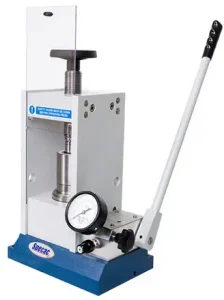
To operate a manual hydraulic press, first make sure that the area around the press is clear and free of obstructions.
Then, place a workpiece – e.g. a pellet die containing a sample material – on the piston. It is critical that the workpiece is centred on the piston.
Next, slowly turn the leadscrew at the top of the press to bring the nose of the leadscrew onto the top of the workpiece. Now, use the handle to pump hydraulic oil into the piston and start applying a load. Continue pumping until the desired load is reached. Once the desired load has been achieved, turn the release valve to release the pressure.
The procedure is the same no matter what object has been placed in the press. Paying careful attention to the positioning of the work and the load that has been applied is key to success.
Operating a manual hydraulic press is a relatively simple process, but it is important to exercise caution when using this type of equipment.
It’s vital to always make sure that the area around the press is clear before starting any operation, and to always follow safety instructions when using hydraulic machinery.
Why use a manual hydraulic press in your laboratory?
For some labs, manual hydraulic presses present an advantage over automatic equivalents. This is mostly due to price; if you aren’t paying for electronically powered equipment, you’ll likely be paying less.
Whether you’ll get value out of a manual hydraulic press depends largely on how often it will be used. If you don’t use a press frequently, operating it by hand isn’t likely to cause much inconvenience.
However, if your workflow relies on pressed samples and your lab staff will need to produce them recurrently, they might find a manual hydraulic press to be quite laborious. In these instances, an automatic press will likely be more convenient and enable a quicker pace of work.
Are you trying to find the right hydraulic press for your laboratory application?
Testing is a critical step in many research processes. It’s critical to use the right equipment to ensure accurate results.
Hydraulic presses are available in a variety of sizes and configurations and choosing the right one for your application can be a challenge. Fortunately, Specac offer a range of hydraulic presses to suit a wealth of applications. With our help, you can find the ideal press to suit your needs, ensuring accurate and repeatable results.


